

Why Do I Feel Guilty Saying No?
Jun 29, 2026You're Not Alone in This
You said no. Maybe to a friend who needed you. Maybe to plans you didn't have the energy for. Maybe to something you would have found a way to say yes to any other week, but this time you just couldn't.
And then came the guilt.
That familiar pit in your stomach. The replay in your head. The wondering if you were too harsh, too selfish, too much. The urge to take it back or over-explain until the other person felt okay again.
If that sounds familiar, you're not alone — and more importantly, nothing is wrong with feeling guilty.
Feeling guilty when you say no is one of the most common experiences I hear from the people I work with. And almost every one of them arrives believing that the guilt is proof that something in them needs to change.
It isn't.
Here's what I want you to consider instead.
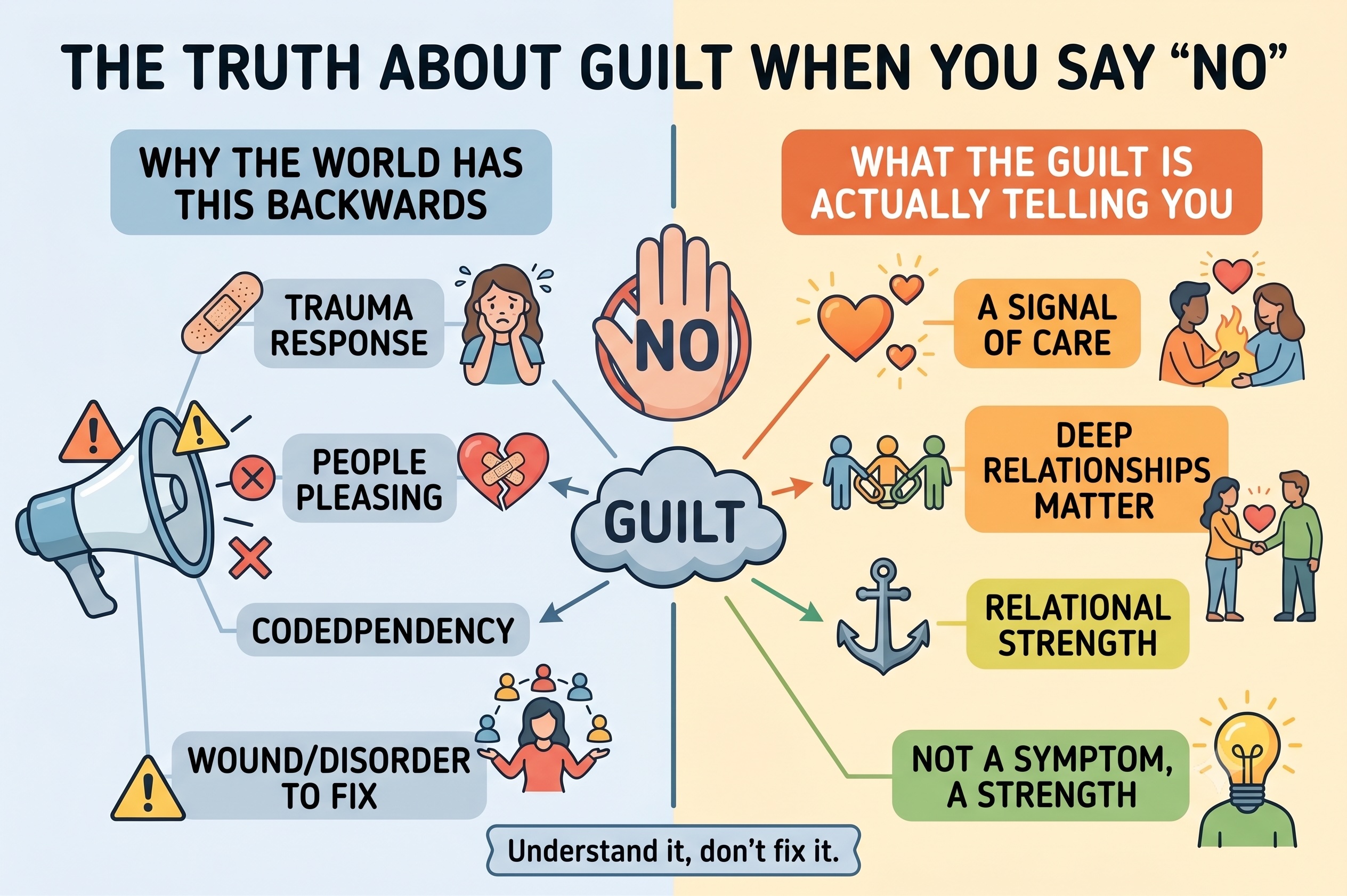
What the Guilt Is Actually Telling You
The guilt you feel when you say no is a signal — but it's probably not the signal you think it is.
Most advice on this topic will tell you the guilt is a trauma response, a nervous system pattern, a wound that needs fixing. Yet that framing leaves out something important: the guilt also tells you that your "yes" means something to you.
You feel guilty because you genuinely care about the people in your life. You feel guilty because relationships matter to you — deeply, fully, in a way that not everyone experiences. You feel guilty because you know what it feels like to be let down, and you don't want to be the person who does that to someone else.
That's not a disorder. That's not a wound. That's a relational orientation — and it's actually one of your greatest strengths.
Why the World Has This Backwards
Here's what most articles on this topic will tell you: your guilt comes from trauma, people pleasing, codependency, or anxious attachment — patterns you need to fix and heal.
But those labels are missing something. They're misunderstanding who you are. The framing puts all the weight on something being wrong with you — when the truth is, your guilt just hasn't been fully understood. Most of the world hasn't understood it.
Your guilt isn't a symptom. It's a signal. It's showing you that you care. And there's nothing to fix about that — there's just something to understand about it.
Your Guilt Is Showing You Something True
The guilt you feel when you say no makes complete sense. It shows you're human. It shows you care about the people you love.
You don't want to hurt them. You don't want to disappoint them. You want them to have a good experience — and you care deeply about staying connected. That guilt is your heart showing up, even in a hard moment.
Your feelings are intelligent. They're responding to something real.
That's not something to fix. That's something to honor.
When Saying No Hasn't Felt Safe
But sometimes the guilt is carrying something else too.
If saying no has ever cost you — if someone got upset, went quiet, pulled away, or made you feel like you'd done something wrong — your heart learned to be careful. Of course it did. That makes complete sense.
But here's what's important: their reaction is information. Not about you. About them — and about what that relationship could hold. (If you're wondering whether your current relationship has those dynamics, these early red flags are worth knowing.)
Think about it from the other direction. If someone you love came to you and said, "I feel so guilty — I really wish I could, but I'm just exhausted" — how would you respond? Maybe you felt a little disappointed. But would you make them feel wrong for being honest? Or would you want them to take care of themselves — and actually want to know where they were?
Most people who care deeply about their relationships already know the answer. Because they'd want that person to be okay. They'd welcome the honesty even when it hurts. That's what healthy relationships look like — there's room for each other's truth, including a no.
And when a warm, honest no still creates tension or distance? That's not evidence you did something wrong. It's information about what that relationship could — and couldn't — hold.
Say No With Your Heart
Most advice tells you to just say no and set a boundary. Remind yourself you have a right to your own limits. But if you genuinely care about the person you're saying no to — you don't have to build hard walls.
You can say no and let them see your heart at the same time.
"I feel so guilty saying this. I really wish I could — but I'm exhausted and I just don't have anything left right now."
That's not a cold boundary. That's not a wall. It's honesty with warmth still in it. It lets the other person know your no isn't coming from indifference — it's coming from someone who deeply cares about them and is also being real about where they are.
Vocalizing the guilt isn't weakness. It's the most relational thing you can do. It keeps the connection alive even in the moment you can't show up the way you wish you could. (And if you're in a relationship where even this kind of warmth and honesty creates tension or withdrawal, these signs might be worth a closer look.)
You don't have to choose between honoring yourself and showing that you care. Those two things can exist together. This is what healthy relationships are made of.
FAQ
Is it normal to feel guilty every time you say no?
Yes — it's extremely common, especially for people who are deeply relational and place high value on their connections. Nothing is wrong with feeling this way. It means you care deeply about the people in your life. And in healthy relationships, your needs and the needs of the people you love don't have to compete — both can be seen, and both can be cared for.
Why do I feel guilty saying no even when I know I want to say no?
Because guilt and clarity can exist at the same time. Feeling guilty doesn't mean you made the wrong choice — it means you care about the person you said no to. You can know with your whole self that you needed to say no, and still feel the weight of not wanting to disappoint someone you love. That's not a contradiction. That's what it looks like to be someone who cares deeply and is also being honest about where they are.
Does feeling guilty about saying no mean I'm a people pleaser?
No — and "people pleaser" is another label that is widely misunderstood. Feeling guilty when you say no says one thing clearly: you care. It's not a character flaw or a pattern to fix. If you want to understand the real distinction, read this: the difference between being kind and being a people pleaser.
How do I stop feeling guilty for saying no?
You don't have to stop the guilt — it is an intelligent emotional signal that is telling you and the other person that you care about them. You don't have to hide it either. Try saying no with the guilt present: "I feel so guilty saying this. I really wish I could — but I'm just not able to right now." Letting the other person see how you feel keeps the connection intact. The guilt is part of how you show up with a full heart. You're not managing it away — you're letting it speak.
Will the guilt ever go away?
Yes — and here's how: the more time you spend in safe, healthy relationships, the more you realize you can share your feelings and needs without losing the connection. You can say "I feel so guilty, I really wish I could" — and the other person sees your heart and meets you there. Because they care about you too. The guilt softens when love is reciprocated, when honesty is welcomed, when you stop having to brace for the reaction.
This is exactly what I help people learn in the Relationship Clarity Program — six months of rebuilding yourself and your relationships from the inside out, so you feel genuinely confident in who you are and can trust yourself again in every relationship. Learn more here.
You Were Never the Problem
If you feel guilty when you say no, I want you to hear this clearly: that guilt is not evidence that you did something wrong — that you're selfish, or that something in you needs fixing.
It's evidence that you care. That your relationships matter to you. That you hold your commitments seriously and you don't take people lightly.
Those are qualities the world desperately needs. The work isn't to get rid of them — it's to build enough trust in yourself that you can bring your full relational self and your own needs into the same room at the same time.
You don't have to choose between caring for others and caring for yourself. That was never actually the choice.
If this resonated with you, you are exactly the person I created the Relationship Clarity Program for. It's a six-month journey for deeply relational people who are ready to trust their feelings and themselves again… as they build deep genuine connections that are fulfilling and can last a lifetime.
→ Learn more about the Relationship Clarity Program
→ Or start here: The Difference Between Being Kind and Being a People Pleaser
Callie Sorensen holds an MSc in the Psychology of Coercive Control and is the creator of the Relationship Clarity Program — a six-module coaching program for deeply relational people who are ready to stop second-guessing themselves in their relationships. She works with people who have been labeled "too sensitive," "too much," or "people pleasers" — and helps them understand that nothing was ever wrong with them.