

The Difference Between Being Kind and Being a People Pleaser
Jun 27, 2026You've probably been told at some point — by a therapist, a friend, a book, or a late-night scroll through the internet — that you're a people pleaser. And with it came the implication that something about you needs to change.
But what if the label itself is the problem?
In this post, I want to offer you a completely different way of looking at this — one that doesn't ask you to stop caring, stop giving, or stop being who you are. Because in my experience working with people navigating confusing and painful relationships, the people who get labeled "people pleasers" are usually the most relationally gifted people in the room. They just haven't been told that yet.
What Does "People Pleaser" Actually Mean?
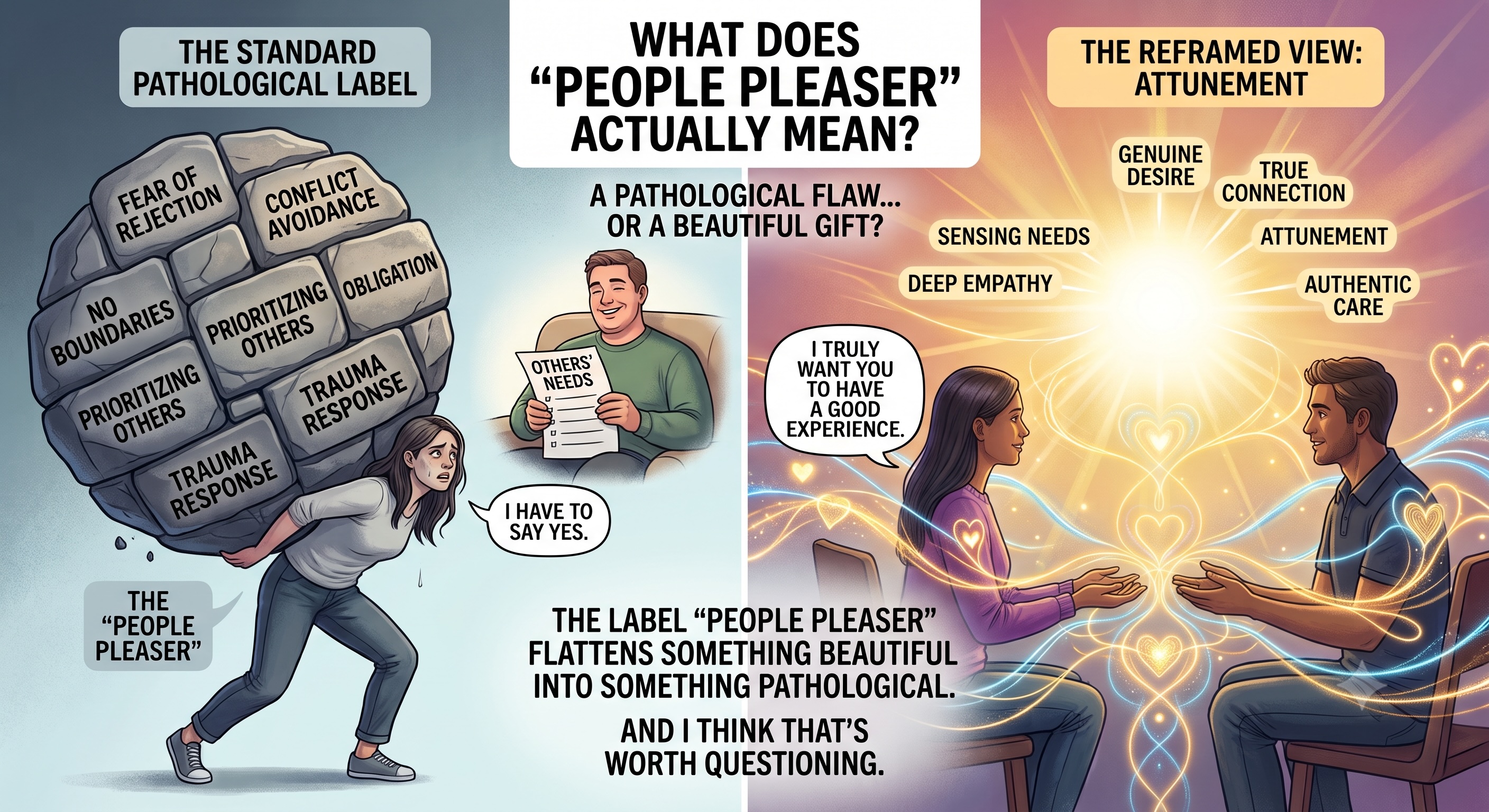
The standard definition of a people pleaser is someone who consistently prioritizes the needs, opinions, and feelings of others ahead of their own. Most experts frame this as a problem rooted in fear — specifically, the fear of rejection, conflict, or disapproval.
The common advice that follows is: learn to act from genuine desire instead of fear. Set boundaries. Say no. Stop doing things for the wrong reasons.
But here's what that framing misses entirely: what if the desire is genuine?
What if you truly do want others to have a good experience? What if attuning to how someone else is feeling isn't fear — it's just who you are? What if caring about others before they even know what they need isn't a trauma response — it's a gift?
And yes — the fear is real. But that fear isn't irrational either. If you are someone who is deeply attuned to others, you can actually sense — often before it's been spoken aloud — when a relationship isn't meeting you. When the other person's values don't match yours. When the care isn't flowing both ways. That fear of disconnection isn't a flaw in your wiring. It's your system accurately reading something real. The problem was never that you were afraid. The problem is that the fear was pointing at something true — and no one helped you see what it was pointing at.
The label "people pleaser" flattens something beautiful into something pathological. And I think that's worth questioning.
Why People-Pleasing Gets a Bad Reputation
Think about it this way: if everyone on this planet operated the way a so-called "people pleaser" does, this world would be extraordinary.
We would all attune to each other. We would all care about how the other person feels. We would all think about the impact of our actions on the people we love. Conflict would dissolve faster. Relationships would be safer. People would feel genuinely seen.
The reason people-pleasing has a reputation problem isn't because caring about others is wrong. It's because not everyone operates this way. And when someone who deeply prioritizes connection and harmony is in a relationship with someone who doesn't — that's when the pain starts.
Your caring nature isn't the issue. The mismatch is.
What's Really Going On When "Kindness" Starts to Hurt
Here's what I see over and over again with the people I work with:
Someone is in a friendship, a romantic relationship, or a family dynamic. They attune deeply to the other person. They notice when the other person is stressed before they've said a word. They adjust, accommodate, show up, think ahead. They cancel their own plans because they can feel their partner is having a hard day. They reach out first. They make space. They give.
And then — slowly — they start to feel resentful. Exhausted. Invisible.
Most therapists would look at this and say: "You're people-pleasing. You need to stop doing things from a place of fear."
But I want to offer a different read entirely.
What I would say to that person is this: What you're doing is what is needed in a healthy relationship. You are attuned to another person in a way that most people never experience in their lifetime. You can feel what they feel. You can anticipate what they need. That is a rare and extraordinary quality.
The problem is not what you're doing. The problem is that they're not doing it back.
They're not attuning to you. They're not noticing when you're exhausted. They're not adjusting their behavior when you're having a hard week. They're not thinking about your experience the way you're thinking about theirs.
That resentment you feel? It's not proof that you've been people-pleasing. It's an intelligent signal. Your emotions are trying to show you something: there's an imbalance here, and you deserve better.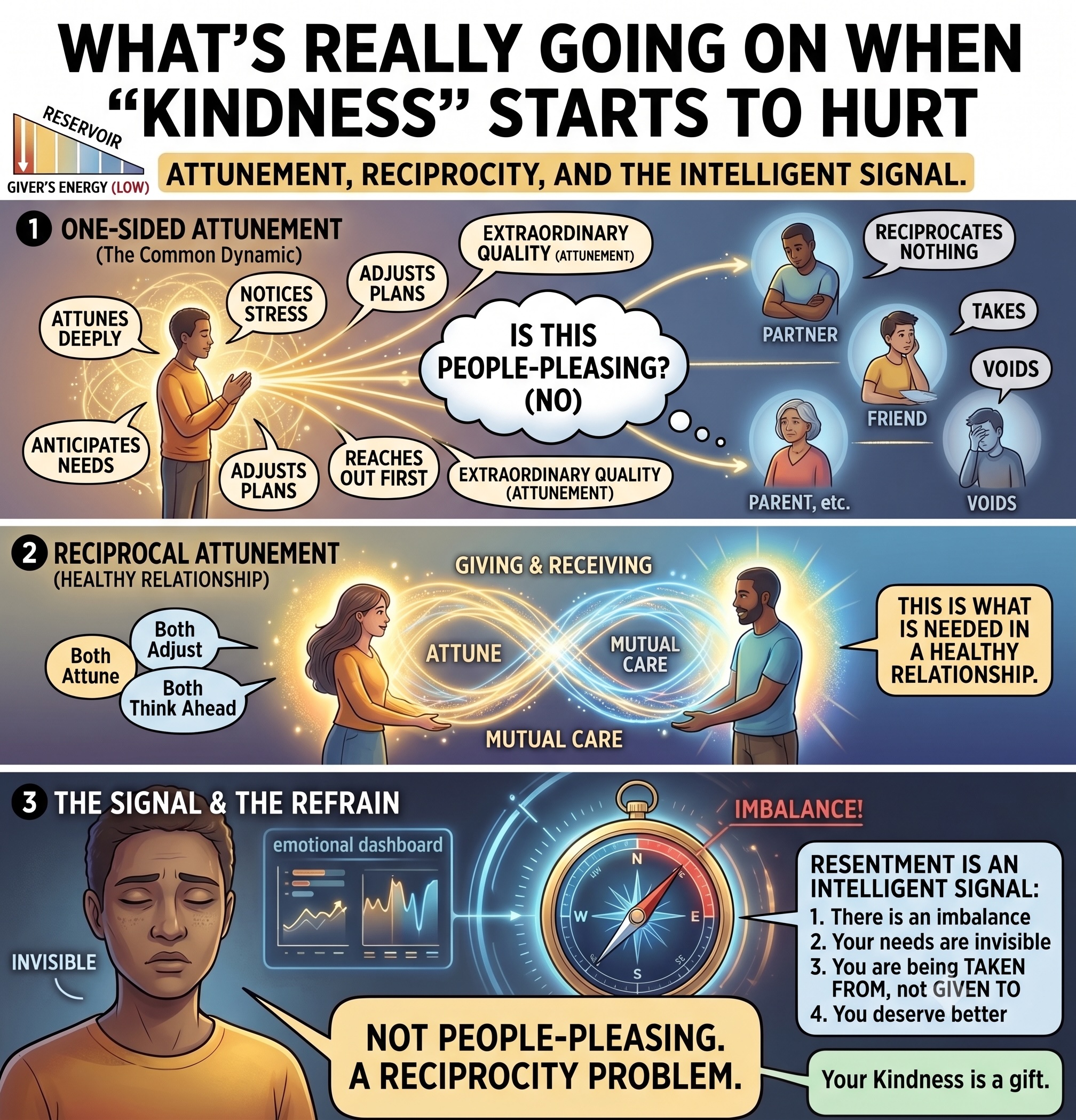
The Real Difference Between Kindness and People-Pleasing
Most content on this topic will tell you the difference comes down to motivation.
Kindness = driven by genuine desire.
People-pleasing = driven by fear.
That framework has some truth in it. But it's incomplete — and for many people, it actually makes things worse. It sends you into your head trying to analyze your own motivations while you're still in the middle of a painful dynamic.
Here's what I actually believe, after years of working with people in exactly this situation:
People-pleasing isn't the opposite of kindness. People-pleasing IS kindness. It's just kindness that isn't being reciprocated.
The behavior is identical. What changes is the relationship it's happening in.
If you bring your attunement, your generosity, your care for others into a relationship with someone who matches that energy — someone who also notices, also gives, also adjusts — there is no resentment. There is no exhaustion. There is no confusion. There is just mutual care, which is exactly what relationships are supposed to feel like.
It's only when those same qualities meet someone who doesn't reciprocate that the dynamic becomes painful. And then the world looks at your pain and says: "You need to stop being a people pleaser." When what it should say is: "You deserve a relationship that can actually receive you."
Wondering what that actually looks like? Here are 11 qualities of a healthy, thriving relationship — not as a checklist, but as a picture of what it feels like when care genuinely goes both ways.
A Concrete Example: The Partner Who Rarely Notices
Imagine you cancel your plans on a Tuesday evening because you can feel — without your partner saying a word — that they've had a hard day. You stay home. You make dinner. You create space for them.
They rarely say thank you. They rarely notice. They rarely ask how your week is going.
You do this again the following week. And the week after that.
Over time, you start to feel drained. Invisible. Maybe even bitter.
Now: is the problem that you canceled your plans? Is the problem that you cared too much? Is the problem that you should have been acting from a different motivation?
No. The problem is that you're in a one-directional dynamic. You are bringing your full caring self — your attunement, your consideration, your sensitivity — into a relationship that isn't bringing the same thing back.
This is not a you problem. This is a mismatch problem.
The exhaustion and resentment you feel are not character flaws. They are your emotions doing exactly what they're supposed to do — showing you that something here is off balance.
What Needs to Change (It's Not You)
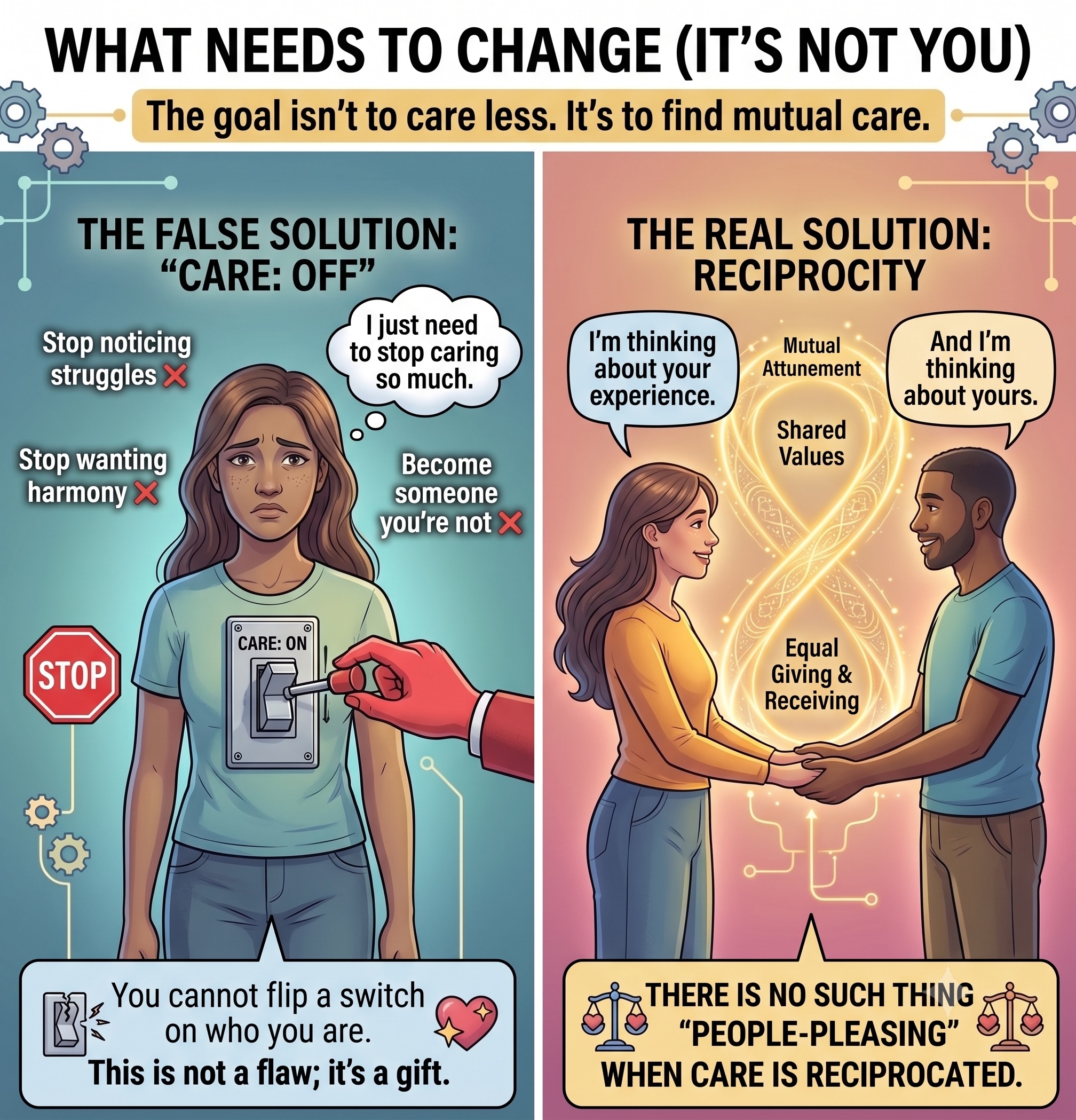
Here's what I want you to hear clearly: you do not need to stop caring.
You cannot stop caring. It's not a switch you can flip. Imagine being told to stop noticing when the people you love are struggling — to stop thinking about their experience, to stop wanting everyone to feel good. That's not healing. That's asking you to become someone you're not.
The world needs more people like you. People who prioritize harmony. People who can feel what others feel. People who lead with care instead of self-interest. This is not a character flaw. This is one of the most important qualities a human being can have.
What needs to change is the quality of the relationships in your life — specifically, whether that care is being matched.
When you are with people who also prioritize relationship values — who also attune, also give, also think about your experience — there is no such thing as people-pleasing. There is only mutual care. You would never feel resentful or invisible because you would both be showing up for each other.
The goal isn't to become less giving. The goal is to be in relationships where your giving is reciprocated.
Why This Matters for Your Relationships Right Now
If you're reading this and feeling a quiet recognition — like something in your chest is relaxing for the first time in a while — that recognition matters. Trust it.
You may be in a relationship, or a pattern of relationships, where what you bring isn't being matched. Where you are giving care that isn't coming back. Where you are attuning to someone who isn't attuning to you.
And if that's true, the solution isn't to become a different person. The solution is to get clarity — on what you're actually feeling, on who you are, on what's really happening in your relationships, and on what you deserve going forward.
That's exactly what I help people work through inside the Relationship Clarity Program. We start with your emotions — learning to read what they're actually telling you, instead of overriding them. Then we build a clear picture of who you are and what matters to you. Then we look honestly at your relationships and what's actually happening in them. From that clarity, you make decisions. Not from fear. Not from guilt. From a place of genuinely knowing.
If you want to go deeper first, join the free masterclass where I walk through the entire framework.
The Bottom Line
The difference between being kind and being a people pleaser is not about your motivation. It's not about fear versus genuine desire. It's not about a character flaw you need to fix.
People-pleasing is kindness. It's just kindness that isn't being reciprocated — and that points to the relationship, not to you.
You are not too much. You are not broken. You are not doing something wrong by caring deeply. You brought something rare and beautiful into a dynamic that couldn't match it. That is not the same thing as a problem with you.
What you need isn't to become someone different. What you need is relationships that finally meet you where you are.
And that starts with getting clear.
Frequently Asked Questions
Is people-pleasing the same as being kind?
People-pleasing and kindness often look identical from the outside — because they are the same thing. The difference isn't motivation. It's whether the care is being reciprocated. When your generosity is matched by others, it simply feels like connection. When it isn't, it creates resentment and exhaustion — which the world mislabels as "people-pleasing."
How do I know if I'm a people pleaser or just kind?
If you're asking this question, here's what I want you to hear: being a people pleaser means you are kind. That's it. The question isn't whether you're one or the other — they're the same thing. The real question is whether that kindness is being given back. If you feel resentful, invisible, or exhausted, that's not proof something is wrong with you. That's your emotions showing you the relationship isn't matching what you're bringing to it.
Can people-pleasing be a good thing?
The qualities associated with people-pleasing — attunement, generosity, care for others' feelings, desire for harmony — are genuinely extraordinary. They only become painful when they exist in a dynamic where they aren't reciprocated. The goal isn't to lose these qualities. The goal is to bring them into relationships that can actually meet them.
How do I stop people-pleasing without becoming cold or guarded?
You don't need to stop being who you are. You were never the problem. What needs to shift is the quality of the relationships around you — not your character. Learning to read your emotions clearly, understand your own values, and see your relationships honestly allows you to keep your warmth while making clearer decisions about who deserves access to it.
Callie Sorensen is a relationship clarity coach with a Master's in the Psychology of Coercive Control and the creator of the CLEAR Method™ — a five-stage framework for resolving relationship confusion from the inside out. She works with people navigating confusing and painful relational dynamics who want to finally trust themselves again.