
Narcissist Recovery Group
Jul 09, 2026You're Looking for Support. Here's What That Actually Means.
Maybe you typed "narcissist recovery group" into Google. Maybe it was "narcissistic abuse support group," "narcissist abuse support group," or "narcissist support group near me." Different words, same need underneath: you don't want to do this alone anymore.
But before you look for just any group, it's worth understanding what a narcissist recovery group actually is — because it's not what most people picture when they hear "support group," and that distinction changes everything about whether it'll actually help.
What Is a Narcissist Recovery Group?
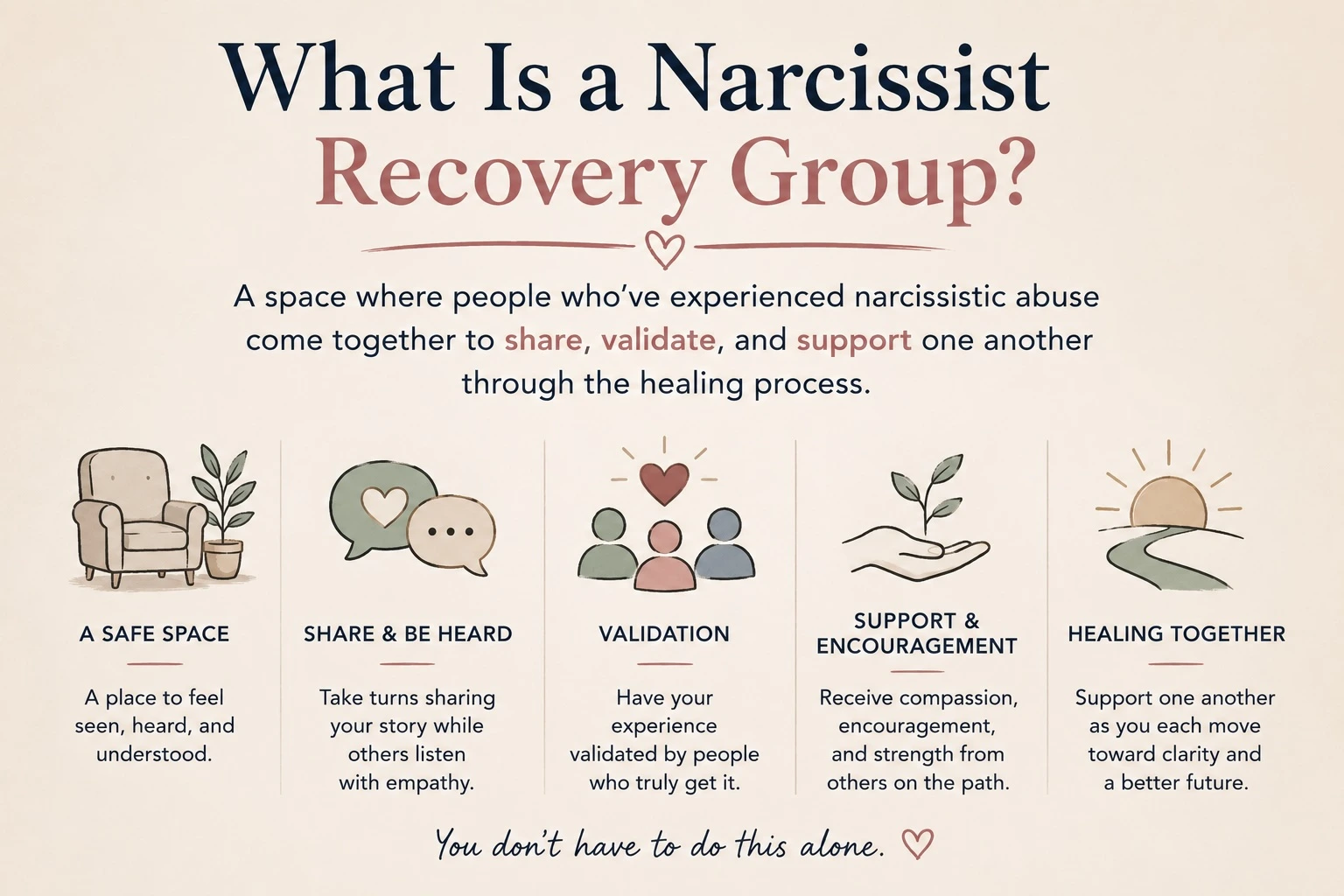
A narcissist recovery group is a space — in person or virtual, peer-led or professionally facilitated — where people who've experienced narcissistic abuse come together to share their experiences, validate what happened to each other, and support one another through healing. Most work the way you'd expect a support group to work: people take turns talking about what they went through, others listen and relate, and the group offers empathy and encouragement.
That model genuinely helps a lot of people, especially early on — being heard and believed after a confusing, invalidating relationship is powerful on its own.
But it's not the only way a recovery group can work, and it's worth knowing there's another model before you assume that's what you're signing up for.
Why Narcissist Recovery Groups Are Important
Healing from narcissistic abuse alone is genuinely harder than it needs to be, for a few specific reasons.
You're not the only one asking the question you think only you have. This is, at its core, why support groups for narcissistic abuse exist at all: being around other people at different points in this process — some just starting to untangle what happened, some already taking action, some further along and rebuilding — means you get exposed to questions you hadn't even thought to ask yet, answered in real time.
Other people can see your pattern when you can't see it yourself. It's genuinely difficult to see your own dynamic clearly while you're inside it. But when you watch someone else's situation get decoded, something clicks faster than it does when you're only examining your own.
The shame lifts. This might be the most important piece. Hearing someone else describe the exact thing you thought only you were struggling with — the replaying, the guilt, the self-doubt, the exhaustion of trying harder than anyone else — creates a specific, immediate recognition: I am not crazy. I am not broken. I am not the only one. That recognition alone starts loosening the shame that keeps so many people stuck in the same loop and silent.
This Isn't a Typical Support Group
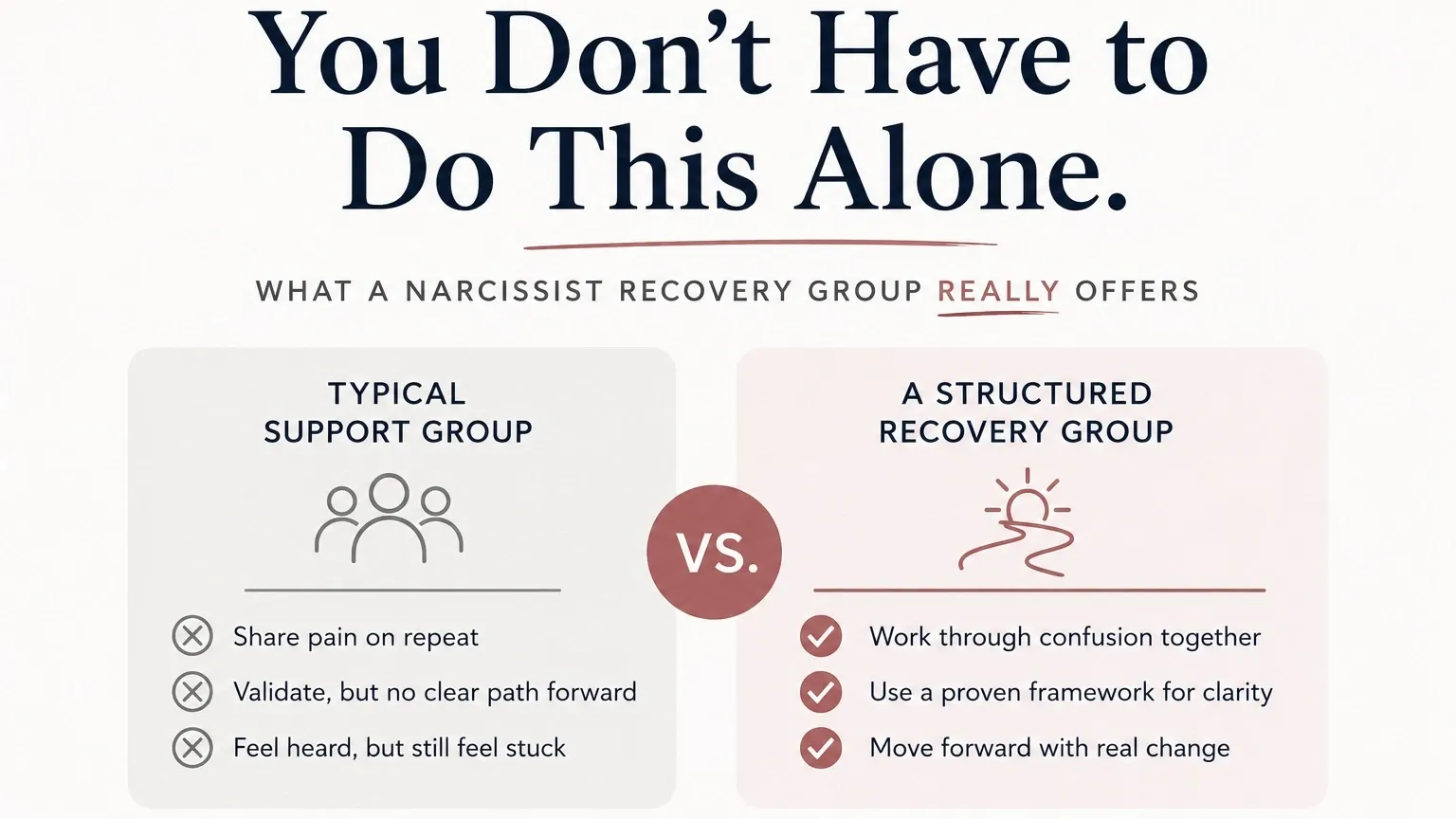
Here's the other model: instead of open sharing and sympathy, a structured recovery group works through confusion together using a specific framework — not retelling what happened over and over, but actually moving through it, together, using a shared process that works.
That's the version this group is. And it's worth being upfront that it's different from what you might be picturing.
There's nothing wrong with the open-sharing model. It genuinely helps some people. But without structure, that kind of space can become a place where people relive and retell their pain on repeat without actually moving through it — which can end up reinforcing the loop instead of closing it.
A narcissist recovery group built around a real framework works differently. The focus isn't on retelling the story as many times as it takes to feel heard. It's on getting clear — together — and using that clarity to actually move forward, using the Clarity First Framework™. The support is real, and so is the validation, but neither one is the destination. They're what makes the actual clarity work possible.
What This Actually Looks Like
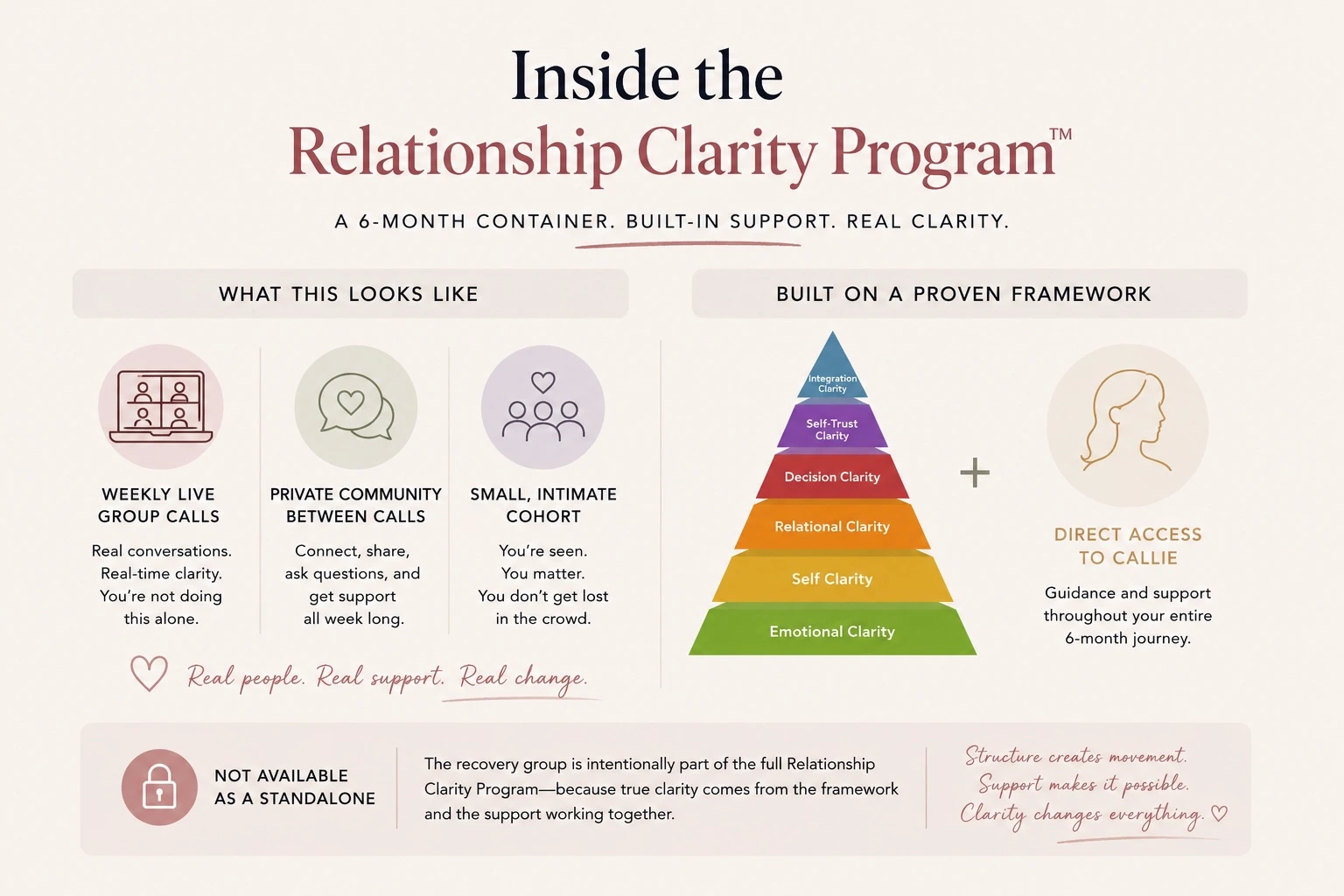
Inside the Relationship Clarity Program™, the recovery group isn't a separate add-on — it's built directly into the six-month container. That means weekly live group calls, a private community for support between calls, and — because it's a small, intimate cohort rather than a massive program — you don't disappear into the background.
On calls, you'll hear other members' dynamics get decoded in real time, using the same framework you're learning to apply to your own situation. People consistently describe the same moment: listening to someone else's story and thinking, that's me. Sometimes someone else asks the exact question you didn't have words for yet, and hearing it answered gives you language you didn't know you needed.
Only Offered Inside the Relationship Clarity Program
To be transparent: the recovery group isn't available as a standalone offering — it's part of the full Relationship Clarity Program, alongside the six-stage Clarity First Framework™ and direct access to me throughout.
That's very intentional. The group works because it's built around the framework, not despite it. A recovery group without the structure underneath it tends to become exactly the kind of space described above — well-meaning, but circling the same pain without a way through it. The group and the framework are designed to work together.
Is This Right for You Right Now?
Group support tends to help most once you have some baseline safety and stability — if you're still in an active, unsafe situation, that needs to come first. But if you're out, processing, or further along and still feel like something hasn't fully resolved, being in a room with people who understand exactly what you've been through — without needing it explained or justified — tends to be exactly the missing piece.
Frequently Asked Questions
Is this about diagnosing the other person? No. The group isn't focused on labeling or diagnosing anyone — it's focused on rebuilding your own clarity and trust in yourself, regardless of what label does or doesn't apply to what happened.
Is this like a typical narcissistic abuse support group? No — most support groups are open sharing spaces without a structured framework underneath them. This group is built around the Clarity First Framework™, so the focus is on moving through the confusion together, not just describing it together.
Can peer support actually help after years of confusing dynamics? Yes — often more than people expect. Hearing your exact experience reflected back by someone else, after years of feeling like the only one, tends to create recognition and relief that research alone doesn't.
Do I need to find a narcissist recovery group near me, or a narcissistic abuse support group near me? No — this group meets virtually as part of the Relationship Clarity Program, so there's nothing to find locally, wherever you happen to be searching from.
Is this a large program where I'll get lost in the crowd? No — it's intentionally a small, intimate cohort, not a massive program.
Take the Next Step
If you're ready to stop carrying this alone, book a free 15-minute consultation call to talk about whether the Relationship Clarity Program is the right fit for your narcissistic relationship recovery. If you want to understand the framework the group is built around first, join the free Relationship Clarity Masterclass.
You can also learn more about the Relationship Clarity Program and join us here.