
How to Heal From Narcissistic Abuse
Jul 06, 2026The Word "Healing" Might Be Part of the Problem
Healing implies something is broken. That something inside you needs to be repaired.
But here's the truth: you were doing relationships correctly all along. You showed up with care, with effort, with the belief that if you communicated honestly and tried hard enough, things could get better. Those aren't flaws. Those are values.
The problem was never you. The problem was a mismatch — what you were bringing to the relationship and what was actually being shown back to you didn't match. Your confusion, your anxiety, your exhaustion from trying harder than anyone else — that wasn't you being too sensitive or too much. That was your feelings doing exactly what they're designed to do: noticing the gap.
So if you're looking for how to heal from narcissistic abuse — or how to heal from a narcissist, recover from a narcissistic relationship, or figure out what narcissist recovery even looks like in the first place — the real starting point isn't fixing what's wrong with you. It's coming back to what was right about you all along.
And if you're not yet sure whether what you experienced counts as this in the first place, this piece on recognizing a toxic relationship is a good place to start.
Why the Usual Advice Isn't Enough
Most guidance on recovering from narcissistic abuse focuses on the same three things: research the topic, go no contact, build stronger boundaries.
Each of those can genuinely help, for a little while. But used alone, without the deeper clarity underneath them, they tend to do one of two things: they either leave you circling the same information over and over without new relief, or they harden you — pulling you further away from the open, caring person you actually are, into someone more guarded, more suspicious, more closed off than you want to be.
That's not healing. That's protection standing in for healing, because nothing has actually resolved underneath it.
Real healing from narcissistic abuse doesn't come from understanding them better, and it doesn't come from becoming harder to reach. It comes from getting clarity — in the right order.
You'll find plenty of long checklists out there — label the abuse, go no contact, protect yourself, love yourself, create new rituals, practice self-care, and so on. None of that is wrong, exactly. But a list isn't a sequence, and pieces without order are exactly why so much of this advice provides short-term relief without ever fully resolving anything.
You'll also find a lot of guidance that focuses heavily on understanding them — becoming an expert in their manipulation tactics, decoding their specific behaviors, and understanding exactly how their memory manipulation worked. That kind of research can feel productive, and it's understandable why so many people go looking for it. But it keeps the center of gravity on them. Real clarity keeps the center of gravity on you — not because their behavior didn't matter, but because you can't out-research your way to a resolution that has to happen inside you.
If you want to understand exactly what's missing from most of this advice, the free Relationship Clarity Masterclass walks through the five pieces actually needed for lasting clarity — including what most therapists and other narcissistic abuse recovery programs tend to leave out.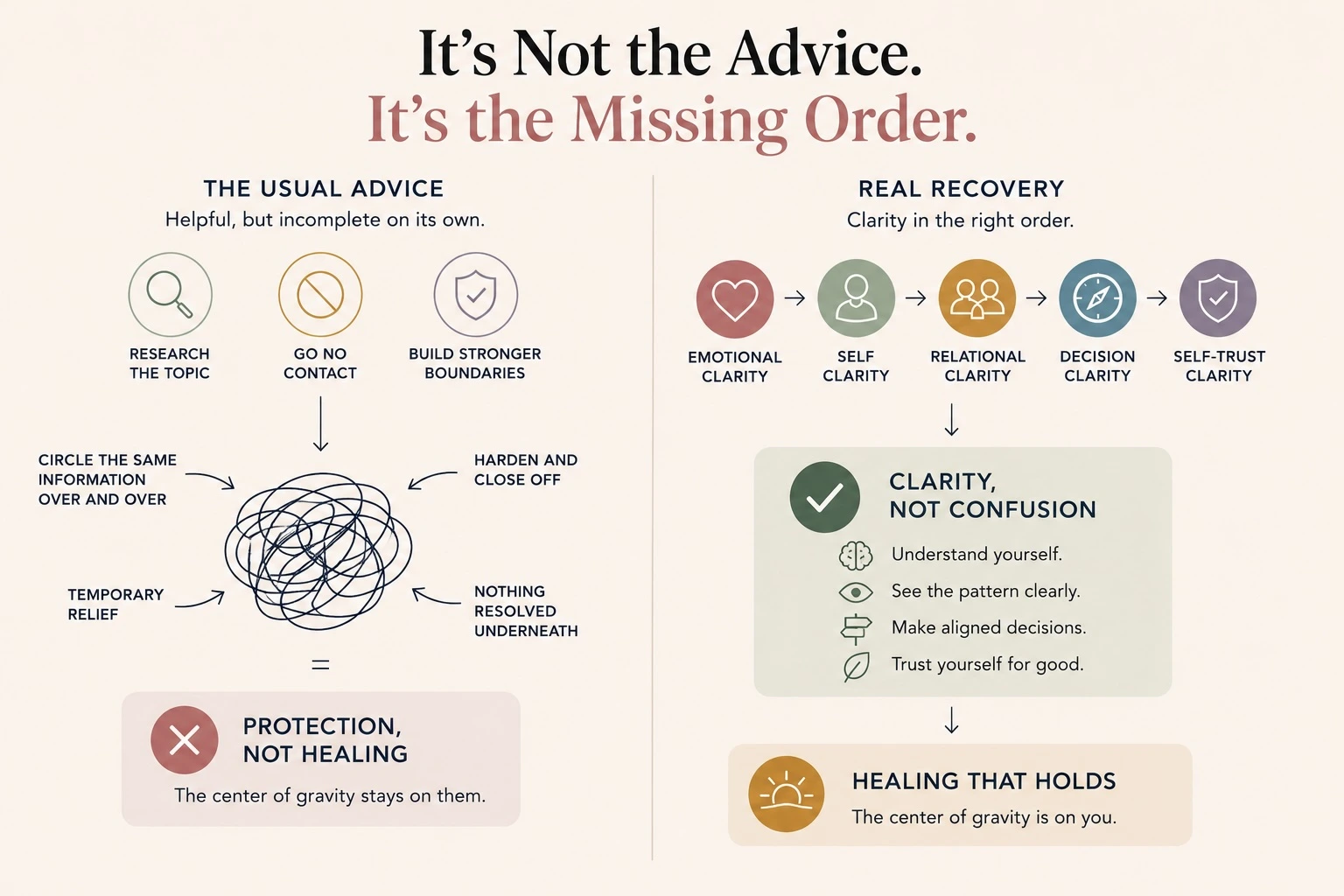
What Healing From Narcissistic Abuse Actually Looks Like
Not the big milestone moments. The quiet, daily ones.
It looks like feeling something — unease, hurt, doubt — and knowing what it means instead of immediately trying to talk yourself out of it. It looks like not needing to regulate a feeling away the moment it shows up, because you've learned to actually listen to what it's telling you instead of treating it like a problem.
It looks like genuine confidence — not performed, not forced — because it's built on something real: alignment with your own integrity. You start making decisions from that grounded place instead of from fear, guilt, or the need for someone else's approval first.
That's what real recovery from narcissistic abuse feels like from the inside. Healing from narcissist abuse — or recovering from a relationship with narcissist partners, as it's sometimes phrased — isn't a single moment where everything resolves. It's this, repeated: noticing, trusting, acting from clarity instead of fear. And it doesn't happen through insight alone — it happens through clarity, built in a specific order.
The Order Matters: The Clarity First Framework™
Most approaches hand you pieces: a coping tool here, a boundary script there. You end up with a pile of information and nowhere to put it. The Clarity First Framework™ — the method at the center of my Relationship Clarity Program™ — works differently. It's a specific sequence, and skipping ahead is exactly why so much healing work stalls out: you get temporary relief, then find yourself back in the same loop.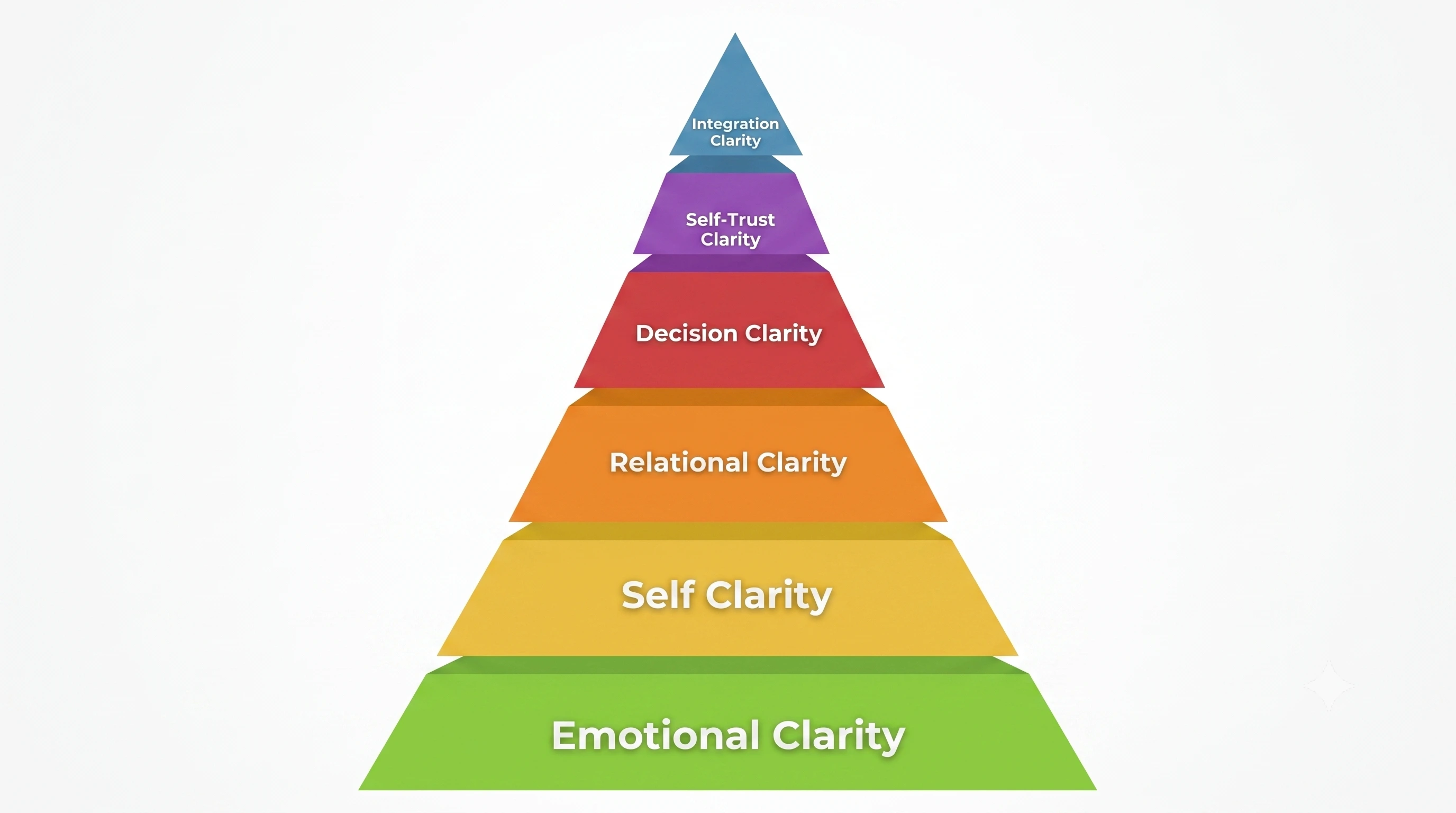
Emotional Clarity: Your Feelings Were Never the Problem
After narcissistic abuse, most people have been taught to see their emotions as the problem — to calm down, regulate, move on, stop overreacting. But your emotions were never dysfunction. They were information.
Think of your feelings as a messenger. At first they tap your shoulder gently — a small unease, a subtle sense that something's off. If that goes unheard, they knock louder: anxiety, hurt, confusion, resentment. Not because your body is against you, but because something important is trying to reach you.
Emotional Clarity means asking a different question than the one you've been taught to ask. Not "what's wrong with me for feeling this?" but "what is this feeling actually showing me?" That single shift is where the self-blame starts to loosen — and where the shame that so often follows narcissistic abuse starts to lift too.
Try this: the next time a feeling shows up — unease, anger, a pull to check on them — pause and ask just one question: "What is this feeling pointing to that matters to me?" Not to fix it or make it go away. Just to hear what it's saying.
Self-Clarity: Reconnecting With Your Own Baseline
This is where a lot of people get stuck, because after a confusing relationship, the lens turns inward in the wrong way. You replay the moments you reacted badly, the times you weren't your calmest, most patient self — and the question becomes: was I part of the problem? Am I the difficult one? What if I’m a narcissist?
Reacting inside an unhealthy dynamic doesn't define your character. It's what happens when someone is pushed past their limits, again and again.
Self-Clarity means reconnecting with your baseline — your actual values, your standards, who you are underneath the confusion — not as a list of ideas, but as something you know to be true in your body. There's an important distinction here: broken means something is wrong with you. Conditioned means something was taught to you. Broken makes you the problem. Conditioned lets you see the system that shaped you, and start coming back to yourself instead of trying to become someone else.
Relational Clarity: Seeing the Pattern, Not Just the Moments
You cannot see a relationship clearly until you've rebuilt emotional clarity and self-clarity first — because your baseline is what you measure everything else against.
Most people get stuck here trying to understand the other person: why they acted that way, whether they meant it, whether they'll change. But true clarity doesn't come from diagnosing someone or landing on the perfect label for them. It comes from comparing their actual behavior to your baseline. Do they take accountability the way you do? Do they move toward repair, or back toward confusion?
Once you can see the pattern instead of a hundred disconnected, confusing moments, something shifts. You stop needing to solve every individual conversation, because you can finally see what was creating the confusion in the first place.
Real repair isn't about the right words in the moment — apologies and good intentions aren't enough if the pattern doesn't actually change.
Decision Clarity, Self-Trust Clarity, and Integration Clarity
The remaining three stages build directly on the first three. Decision Clarity is where clarity turns into grounded action instead of endless hesitation. Self-Trust Clarity is where the doubt stops resurfacing, so you're no longer relying on outside validation to know what's true. And Integration Clarity is where all of this gets applied to every relationship in your life, not just the one that brought you here.
Going deep on each of these is exactly what the Relationship Clarity Program™ is built for — applying the full framework to your actual life, your actual patterns, and your actual decisions, with real support while you move through it.
If you want to go deeper on the framework itself first, the free Relationship Clarity Masterclass walks through all the pieces needed for lasting clarity — including what most therapists and other narcissistic abuse recovery programs tend to leave out.
Why This Is What Actually Makes Healing Hold
You can hear all of this and feel a genuine click — that's real, and it matters. But insight alone doesn't always hold once life happens again: a memory surfaces, they text, doubt creeps back in. That's the same loop we cover here — it doesn't mean failure. It just means the deeper stabilizing hasn't fully happened yet.
That's the difference between understanding what happened to you and actually healing from it. Understanding can happen in an afternoon. Healing happens through guided application, repetition, and real support — which is exactly why this work is so hard to do entirely alone.
Frequently Asked Questions
How do I recover from a narcissistic relationship? This is really the same question as how to recover from a narcissistic relationship in general, or recovering from a relationship with a narcissist specifically — the same way you heal from narcissistic abuse in any context, by rebuilding clarity in the right order, starting with your emotions, then your sense of self, then your ability to see the relationship's pattern clearly.
Is recovering from narcissistic relationship trauma different from general narcissist recovery? Not really — narcissist recovery works the same way whether the relationship was romantic, a friendship, or family. The framework doesn't change based on the relationship type; it changes based on rebuilding your own clarity, which applies everywhere.
How long does it take to heal from narcissistic abuse? It's different for everyone, but healing tends to take longer when it relies on insight alone. Structured, guided support — moving through clarity in the correct order — tends to create faster, more lasting results than research and willpower alone.
Can you fully recover from narcissistic abuse? Yes. Recovery isn't about erasing what happened — it's about rebuilding a clear, stable sense of yourself so the relationship no longer runs your inner world.
Why do I still get pulled back in, even after going no contact? This is often what's called "hoovering" — part of the idealization-devaluation-discard cycle common in narcissistic relationships, where contact resumes just as you're starting to feel steady again. No contact protects you from the outside pull, but it doesn't resolve the inside pull — the part of you that still isn't fully settled in your own clarity. That inside piece is what this framework is built to address.
Is going no contact enough to heal? No contact can be an important, even necessary, step for safety. But distance from the person isn't the same as clarity within yourself — that's the piece no-contact alone doesn't provide.
How do I heal from a narcissist if I'm still processing what happened? Start with Emotional Clarity — learning to trust what you're feeling again is the foundation everything else is built on. Trying to skip ahead to "moving on" before that groundwork is in place is usually why healing doesn't stick.
Take the Next Step
Whatever term brought you here — healing, recovery, narcissistic relationship recovery — the next step is the same. Understanding this framework is the first piece. Moving through it, with real support, is what makes it hold. If you're ready for that, join the Relationship Clarity Program or book a free 15-minute consultation call to talk about where you are right now.